
A thousand years of history
From watchtower to great medieval fortress
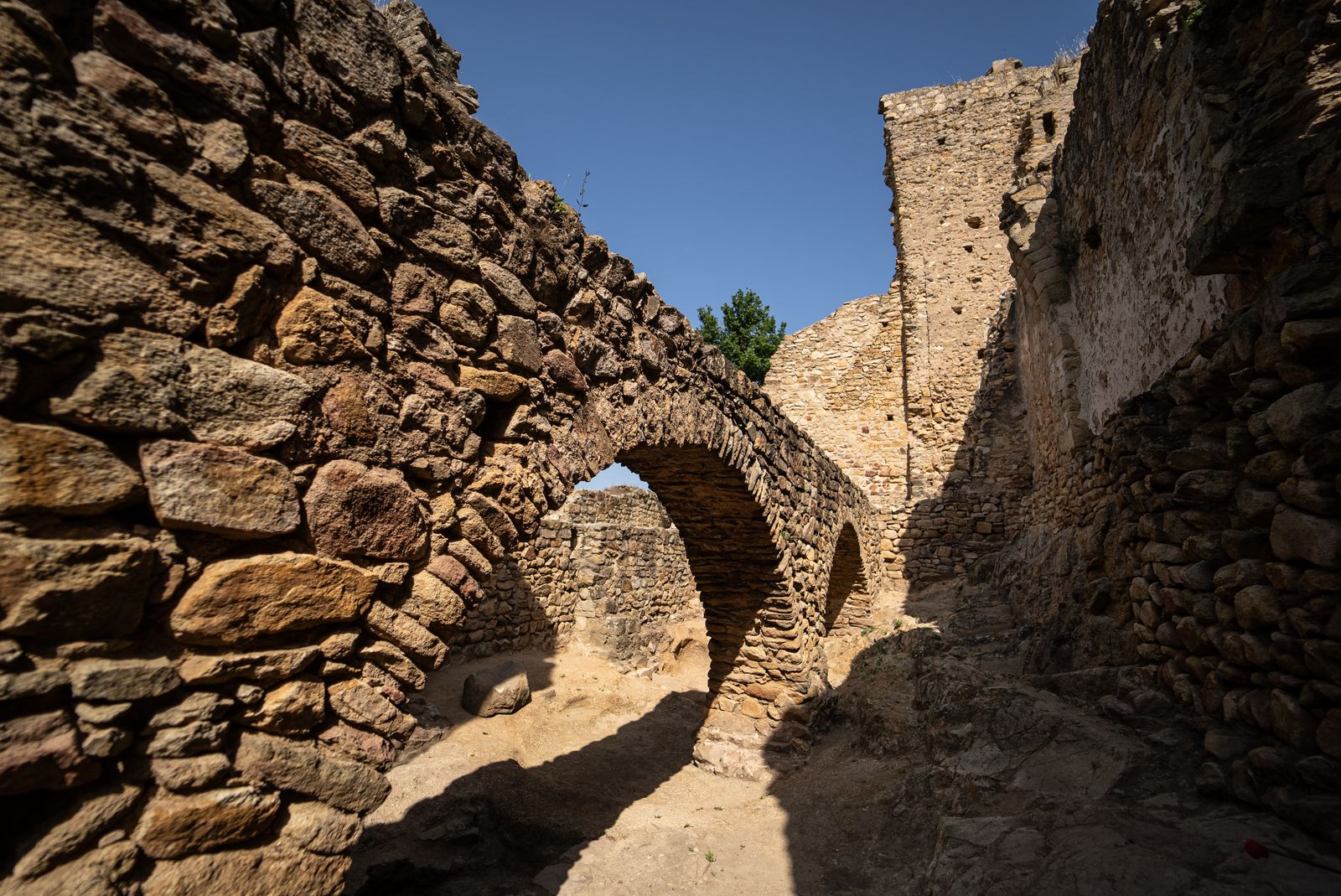
Palafolls Castle overlooks the lower reaches of the Tordera river, a natural corridor between the coast and the interior that is still of great territorial importance today. This strategic position explains why the site was occupied and how it was transformed into a great medieval fortress.
The complex has been declared a Cultural Asset of National Interest (BCIN).
Archaeological evidence places its origins between the 9th and 10th centuries. From the 11th century onwards, it was linked to the Palafolls lineage, which gave its name to the fortress and to the barony.
Power was shared between the viscounts of Cabrera, who held high jurisdiction, and the lords of Palafolls, who were responsible for civil affairs and for part of the seigneurial rights. In 1382 the castle and the barony were definitively incorporated into the Viscounty of Cabrera.
Source: Castle welcome panel (2026)
Timeline
4th century BC
The hill is already inhabited in Iberian times: a settlement is established there that lasts until the Roman imperial period.
Source: palafolls.cat, “Projecte de conservació i restauració del BIC Castell de Palafolls”
9th century
Some wall facings in opus spicatum show that the castle’s origins date back to the 9th century.
Source: palafolls.cat, “Projecte de conservació i restauració del BIC Castell de Palafolls”
968
A founding document of the monastery of Sant Pol de Mar already refers to a castle at Palafolls.
1035
The castle is already documented.
Source: palafolls.cat, “Projecte de conservació i restauració del BIC Castell de Palafolls”
Late 11th century
The barony of “Palafolis” comes into being under the rule of the Umbert family of Montseny, or of Ses Agudes, with jurisdiction over the present-day municipalities of Malgrat de Mar, Palafolls, Santa Susanna and part of Blanes.
1113
Ramon Berenguer III grants high jurisdiction to the viscounts of Girona, who would later become the Cabrera family, while the Palafolls family keep low jurisdiction.
13th–14th centuries
A golden age: the Palafolls family enlarge the castle enclosure and found Vilanova de Palafolls, present-day Malgrat de Mar. Most of the castle’s surviving buildings date from this period.
1381
The last descendant of the Palafolls family sells the castle to King Peter the Ceremonious.
1382
The king sells the castle to Viscount Bernat IV de Cabrera for 21,000 Barcelona pounds, and the fortress becomes part of the Cabrera network of castles.
1471
During the war between the Generalitat and King John II, the castle passes to Armendáriz, a Generalitat captain who had switched to the king’s side.
16th century
The last alterations to the castle, made to counter the threat of pirate attacks.
Source: palafolls.cat, “Projecte de conservació i restauració del BIC Castell de Palafolls”
1572
With the decline of the main line of the Cabrera family, the castle passes to the Montcada family and, in 1722, to the Medinaceli family.
17th–18th centuries
Decline and abandonment: many of the structures fall into ruin.
1880
After lengthy court proceedings, the castle is acquired by the Spanish State.
1949
It is declared a Cultural Asset of National Interest (BCIN).
1966
The association “Amics del Castell de Palafolls” is founded to look after the conservation of the castle.
1970
Excavation and consolidation work begins under the direction of the architect Joan Bassegoda i Nonell.
1993
Restoration projects begin, aimed at enhancing the castle and turning it into a venue for cultural activities.
Source: palafolls.cat, “Projecte de conservació i restauració del BIC Castell de Palafolls”
2024-2026
Archaeological excavations and restoration funded by the NextGenerationEU programme: the most ambitious intervention ever undertaken at the fortress.
2026
After the official ceremony on 9 October, the castle reopens to the public on 10, 11 and 12 October.
Sources
The castle page on palafolls.cat cites as its sources the Enciclopèdia Catalana, the Viquipèdia, the Consell Comarcal de la Selva, the Viscounty of Cabrera and texts by Joan Bassegoda i Nonell.